

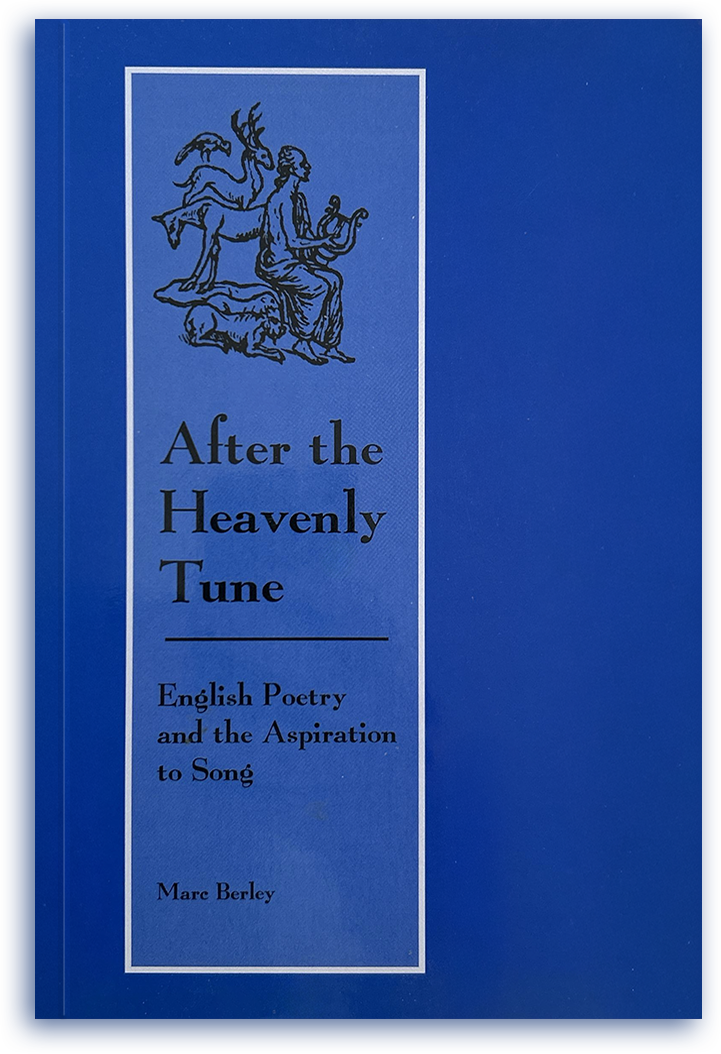
After the Heavenly Tune
“I read this book with admiration for its remarkable thoroughness…and truly striking range.” –Frank Kermode
“The breadth of Berley’s book is admirably ambitious. After the Heavenly Tune is full of suggestive readings of major poems.” – Early Modern Literary Studies
“What do poets mean by saying ‘I sing?’ Marc Berley has a full answer.” – Bibliotheque d’Humanisme et Renaissance
Berley reveals the extent to which English poetry has aspired to the condition of music. –CHOICE
Why, after Homer, do most of the West’s greatest poets from Virgil to Wallace Stevens, write that they “sing” when in fact they write? After the Heavenly Tune offers an expansive answer to this engaging question. Beginning with the complex relationship between music and poetry in the West – defined and refined by Plato, Aristotle, Augustine, Boethius, and Sidney – Berley then examines the writings of such major English poets as Shakespeare, Milton, Yeats and Stevens, all of whom return to the Pythagorean idea of speculative music, or “the trope of song.”
Berley’s chapters on Shakespeare and Milton unfold the remarkable development of the two “speculative musical poetics” most central to the history of English poetry. His last two chapters on romanticism and modernism draw an intriguing line from Wordsworth to Stevens in which the aspiration to song becomes a dazzling means of exploring, scrutinizing and redefining the burdens and achievements – poetic, philosophical, social, and personal – of individual poets in their times. Uncovering the deeper meanings behind the metaphor of song, Berley concludes by relating ancient, Renaissance, modernist and postmodernist aspirations, including those of such theorists and composers as Adorno, Schoenberg and Wittgenstein.
Combining new and old critical methods in insightful ways, this study is the first of its kind to analyze the large questions about poetic authority and musical aspiration. Written in prose that often achieves the condition of music it describes, After the Heavenly Tune illuminates a subject central to the history of poetry and poetics – the aspiration of poetry to a condition of song.

Writer, editor, and musician
Sign Up for Marc’s Newsletter
Copyright © 2026 Marc Berley. All rights reserved. Powered by PMI